
Happy Constitution Day!
In 2004, Senator Robert Byrd proposed some federal legislation that became law. In some ways, this was a curious event. The law specified that on every September 17th any American school receiving federal funding would be required to teach children about the US Constitution.
You might think that our schools would not need a specific requirement to educate their students about the most important document in our history. Then again, you might feel that some of our elected politicians may have missed class that day in September.
Eventually, September 17th had a name change – to Constitution Day (and Citizenship Day). This is not a federal holiday, but a ‘civic observance’. Federal agencies and local civic organizations sometimes mark the date with talks and lessons regarding the importance of the historic document.
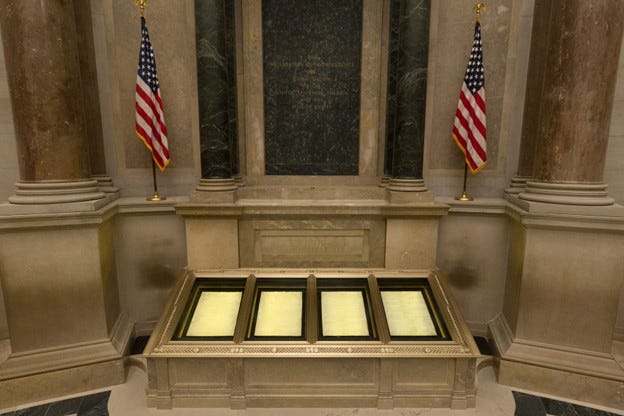
For example, to mark this year’s event, the entire constitution will be put on display for the first time in history. This display is set up in the rotunda at the National Archives in Washington DC for just a few weeks. But if you cannot make it there, you can view this virtual exhibit.
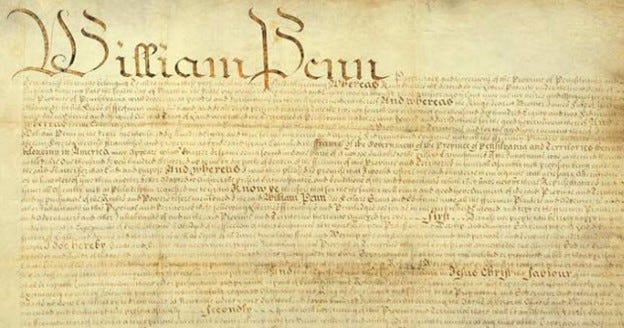
It is impossible to read or watch the news for more than a few minutes without running into some reference of our hallowed documents. Often, the mention is in connection with the legality of some action by a politician, or in relation to an individual’s rights being supported or violated. Often, the Constitution is confused with the Bill of Rights. In both cases, there is sometimes a bit of confusion regarding the concept of our rights. In various media, there is sometimes the suggestion that these documents have granted rights to Americans, rather than recognizing our inherent rights. This is an important distinction with ideas that go back at least to William Penn’s Charter of Privileges for settlers in Pennsylvania (1701). This charter emphasized religious freedom, but also discussed other aspects of personal liberty.
Rather than granting rights to US citizens, the constitution may be better described as a legal document that protects Americans from their own government. Rather than appearing to grant rights or powers, the document expresses quite a bit of instruction in the negative. “Congress shall make no law” (First Amendment) “The right of the people to keep and bear Arms shall not be infringed” (Second Amendment).
This gun business has very unfortunately received a great deal of attention lately. The Second Amendment exists, in some people’s minds, as referring to the ability to hunt, or use guns for sport, or protection against crime. This is all true, but ignores the primary purpose of the law, which is to protect American citizens from their government. The idea is to prevent politicians from possessing an exclusivity on the power of force.
The constitution and Bill of Rights recognize our liberty as ‘Natural Rights” which are not granted by the state. This is not a common concept. Many other constitutions really do grant rights which may be altered or withdraw by the government. This includes the usual suspects of China and North Korea, but other countries allow the suspension of citizen’s rights – these include India and Egypt, and Russia in an extreme case.
The constitution restricts the government in many other ways, most importantly, by describing the ways power can (and cannot) be exercised among the three branches of government.
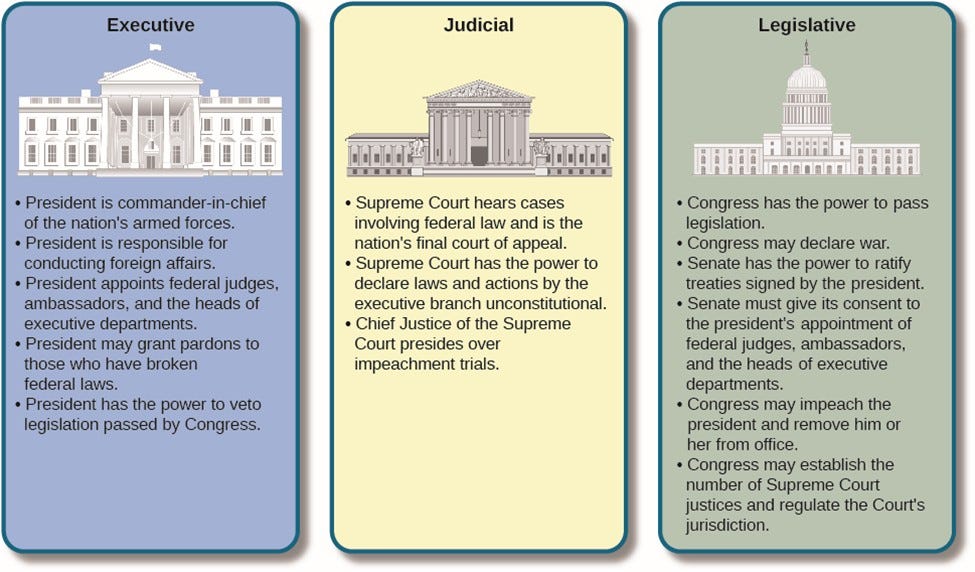
These constitutional rules are designed to limit the powers that the government does possess to one of our three respective branches, to avoid the concentration of power with only one group (or executive).
This does become a problem when one branch (Congress) avoids exercising its powers, while another branch (the executive) attempts to usurp the powers of the other branches.
Every president has attempted to exercise powers that the Constitution does not grant them. Recently, President Biden defended warrantless surveillance, which is clearly unconstitutional. He violated the War Powers act (as nearly all modern presidents have done). Free speech was suppressed during the pandemic, and the president sometimes believed non-constitutional legislation was enshrined in that document.
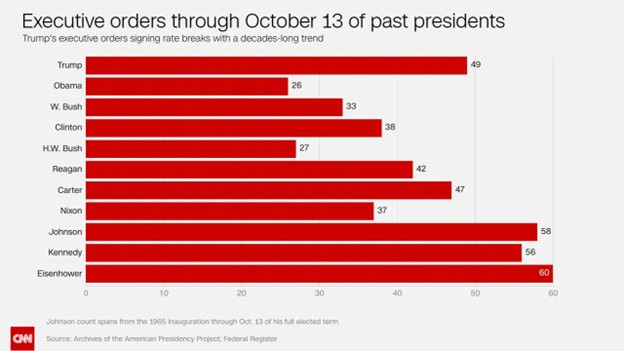
The current president, though, has put most past executives to shame with the volume of unconstitutional actions that have barraged us. It does not seem to matter how often his orders are found to be unconstitutional, he just keeps generating new attempts. While he does not yet hold the record for absurd executive actions, there is plenty of time to be entered into the Guinness Book of World Records.
Next Year, Constitution Day will have greater significance than ever, as it occurs during America’s 250th birthday. Already, the President has planned an array of terrible ideas that promise to cheapen this historic year with historically bad ideas.
But most of us can spend some time reflecting on the real meaning of a document that was published by a group of very brave (and forward-thinking) individuals so long ago. In downtown Philadelphia, in a building that still stands, a constitution was written that protects American citizens from their own government. Fortunately for us, this constitution also still stands.
Reform Congress is a collaboration between Liz Terwilliger and Stephen Wahrhaftig.