
The Final Stamp Act
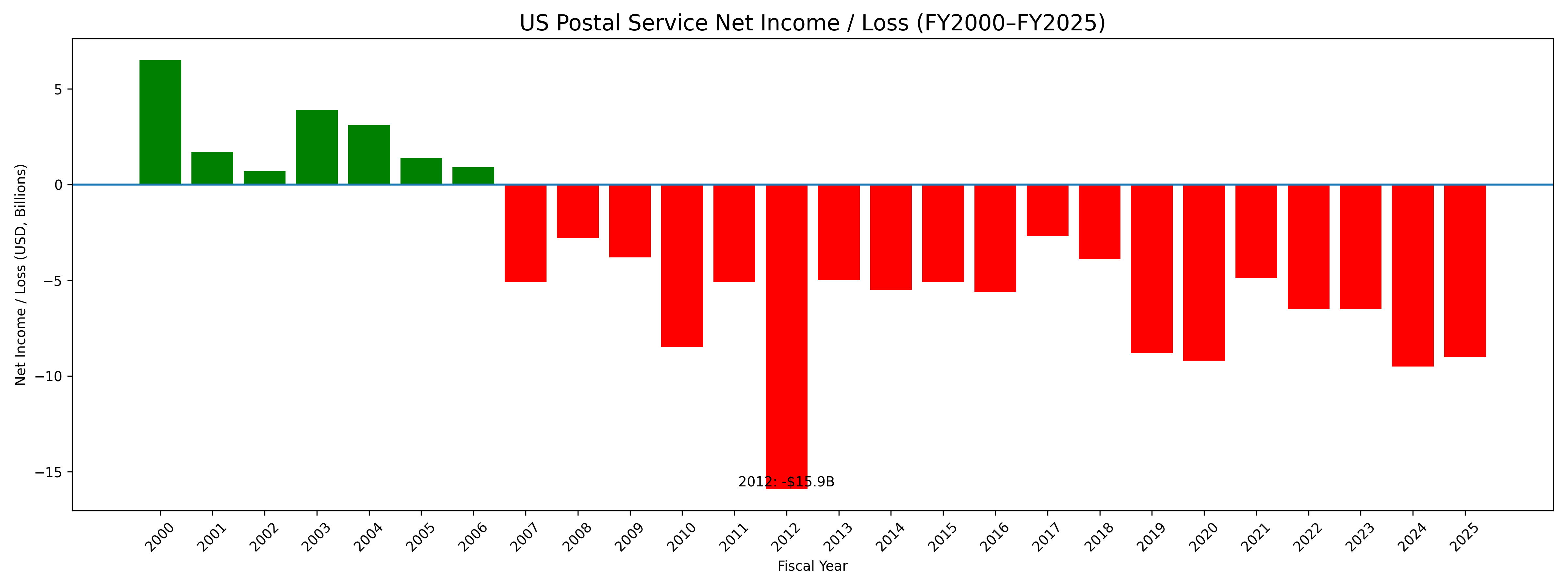
Last year, Denmark began its turn in the rotating European Union leadership and made headlines by adding women to its lottery system for mandatory military conscription. Around the same time, Denmark also stopped delivering mail. In England, Royal Mail operates as a private corporation, and investors can even buy stock in Portugal’s mail company. Germany, meanwhile, holds a minority interest in Deutsche Post/DHL. Here at home, 2025 is also the year the USPS lost $9 billion.
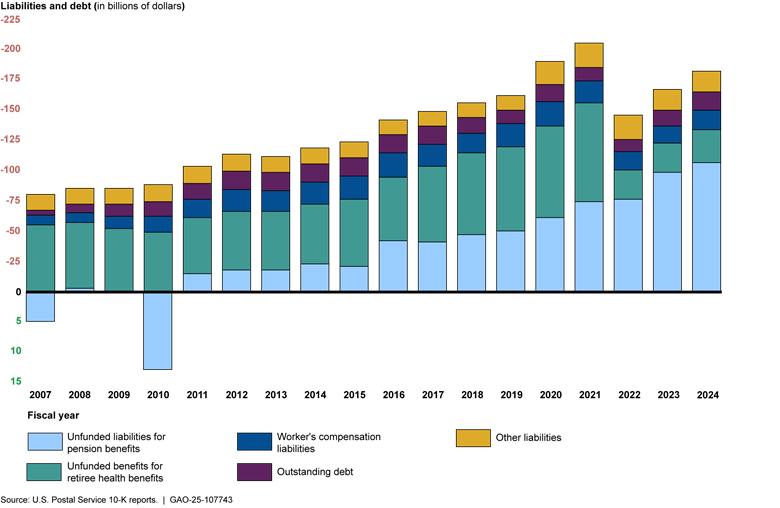
Beginning this Summer, the cost of mailing a letter or card will rise to 82 cents. Even so, the postal system projects a massive cash shortfall by next February. If ever a government system looked unsustainable, mail might be the clearest example. Our postal system has lost over $109 billion through 2025, a figure that does not include an additional whopping $53.5 billion in unfunded employee liabilities including retirement and other benefits. Because the post office cannot cover these obligations, the burden ultimately falls on the taxpayers, with no plan for correction. Higher postage rates will not solve the problem.
The USPS operates under congressional oversight, and the establishment of an ‘exclusive’ postal system is codified in the Constitution. That ‘exclusivity’ has eroded over the years with the rise of private carriers like FedEx, UPS, DHL, etc. Interestingly, while in transit, all mail is literally owned by the postal system, and even your mail box is considered government property (unless it breaks, then ownership reverts to you).
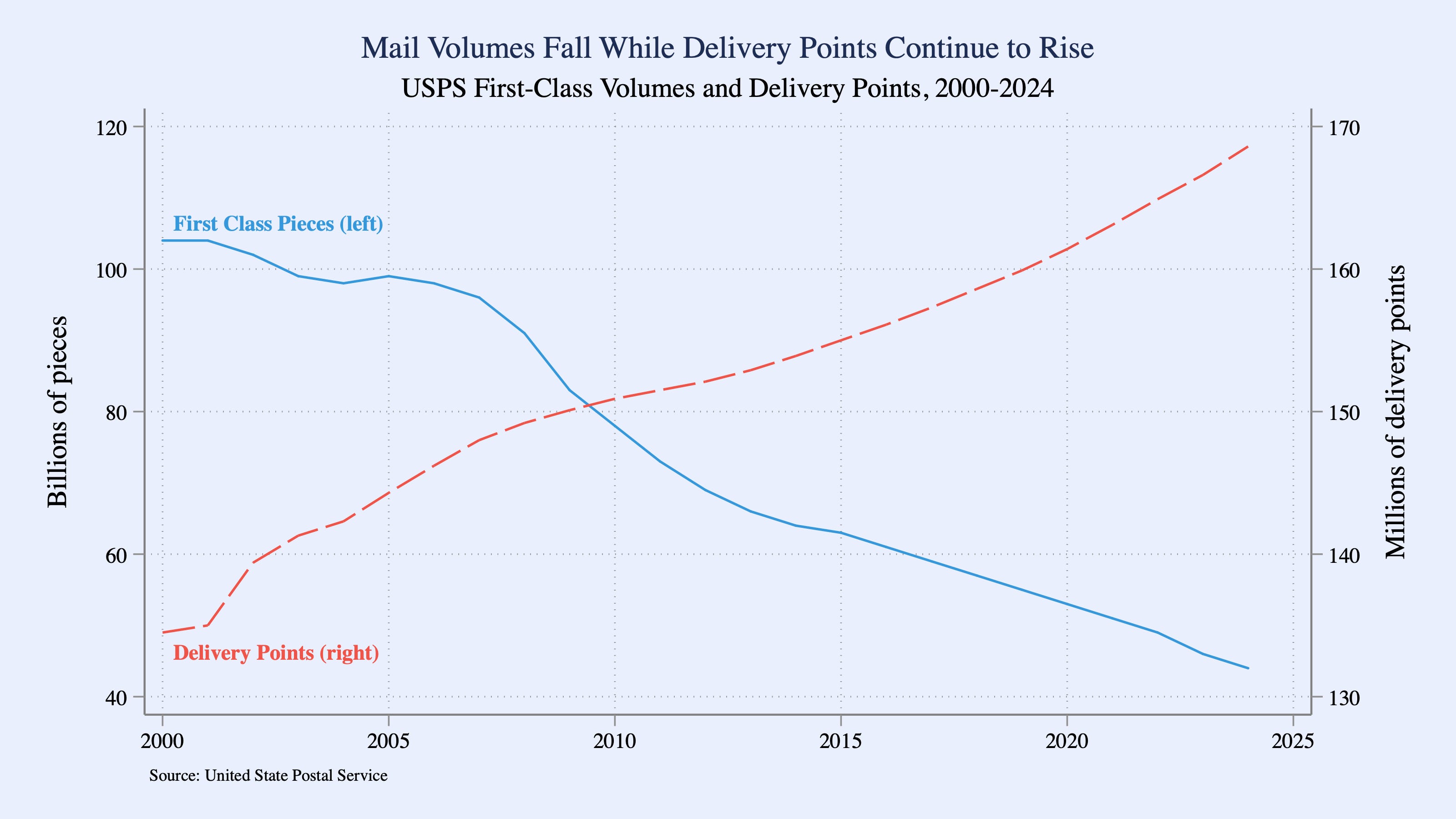
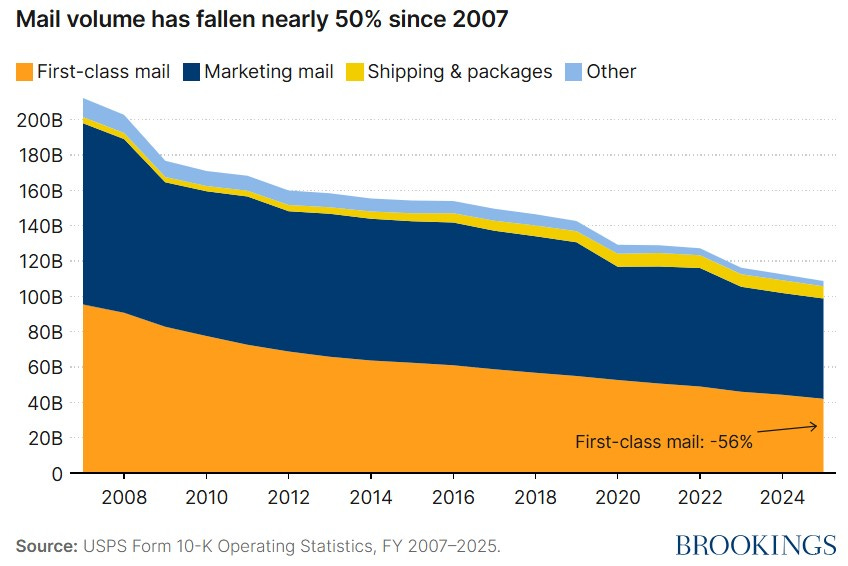
The problems with maintaining a national postal system, like many legacy government systems, stems from the fact that the laws were established when the country was young and small. Today, traditional person-to-person mail is in rapid decline, even as the number of delivery points continues to grow – by roughly one million new addresses each year! Many in hard-to-reach locations.
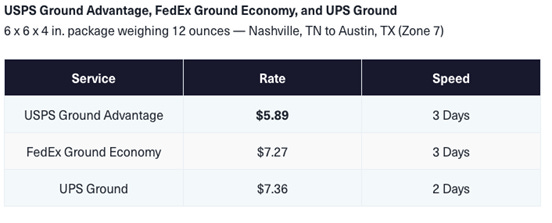
Despite persistent complaints, the post office outperforms private carriers on cost and, at times, speed.
Yet unlike FedEx and UPS, it is losing billions annually. This raises an important question: is the USPS a business or is it a public utility? The uncomfortable answer is that it tries to be both.
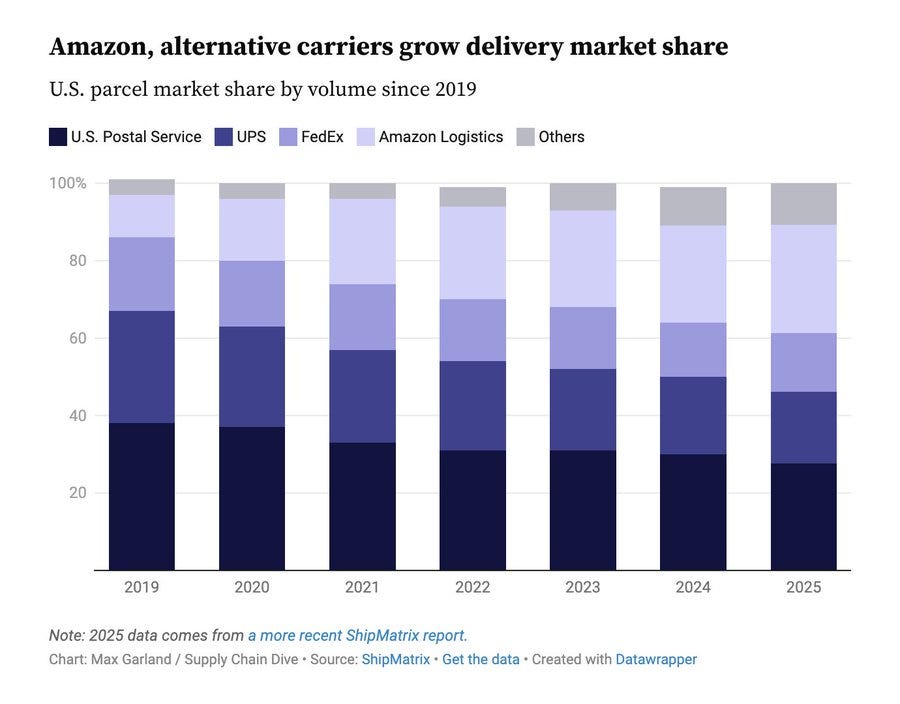
The postal system’s largest customer is none other than Amazon. A new package-handling agreement was recently negotiated after Amazon threatened to reduce its shipping volume. Even with this deal, package volume is expected to drop by about 20% from last year, though the post office will still deliver over a billion Amazon packages this year. By contrast, both FedEx and UPS have intentionally reduced their reliance on Amazon, citing thin margins and the risk of being overly dependent on a customer that is rapidly building its own delivery network. Amazon is already the largest package delivery service in the country.
One of the largest problems facing the USPS is its mandate to provide uniform service and pricing, even to rural and hard-to reach areas. Its commercial competitors face no such constraints. As the Brookings Institute reports, “Both UPS and FedEx apply delivery surcharges to shipments destined for zip codes classified as rural, extended, or remote, raising per-shipment costs for businesses operating in less dense areas”. This leaves the USPS with a difficult equation: declining mail volume, expanding delivery obligations, and rising operational costs. Taxpayers are funding a service they use less and less, even as it becomes more expensive to maintain.
Another part of the problem is the pricing structure. Every time you purchase a Forever Stamp, you are effectively subsidizing junk mailers. More than half, about 52% , of all USPS mail is the stuff you throw into your recycling bin as soon as it arrives. While mailing a single sheet of paper (a first-class letter) now costs 78 cents to mail, bulk mail rates can be as low as 18 cents per piece.
Mounting losses at the post office are also driven by growing, largely unfunded employee liabilities. These long-term obligations will ultimately cost taxpayers far more than incremental increases in postage rates can cover.
Between 2007 and 2025 USPS mail volume dropped by 50%. This decline will continue to accelerate just as costs to maintain a shrinking system increase.
Congress oversees the postal system, and meaningful reform is long overdue. The first step is to answer that question, is mail a public utility or a business? Right now, it is an uneasy combination of both.
Modern communications, phone service and internet access, can now be delivered wirelessly, even from Space. A mailed Christmas card, however, still must be physically delivered by hand. The big cost of doing this is with rural, hard-to-get-to addresses. If Americans want to preserve universal, affordable mail delivery, while reducing financial labilities, a hybrid approach may offer a path forward.
There is no guarantee that privatization would lower costs. Removing the USPS monopoly on first-class mail could introduce competition, but private carriers might still charge more, especially in less profitable areas. What seems more certain is that reform could slow the growth of losses and liabilities that currently burden the taxpayer. If rural delivery is treated as a necessary public utility, then Congress could regulate prices and subsidize unprofitable routes, much like a utility. Other options might include variable pricing based on delivery frequency or location, charging more for weekend service or for remote addresses.
Such a system would not be perfect, in fact no better than Amtrak being forced to serve routes with few riders, but it could better manage overall costs, increase efficiency, and reduce long-term liabilities, including those tied to a large federal workforce. Other solutions are worth exploring, most involving some sort of hybrid government/private system.
What is clear is that the current system is not sustainable. The USPS is a broken system, and the problem is becoming rapidly worse. Congressional inaction will only delay a very serious financial reckoning.
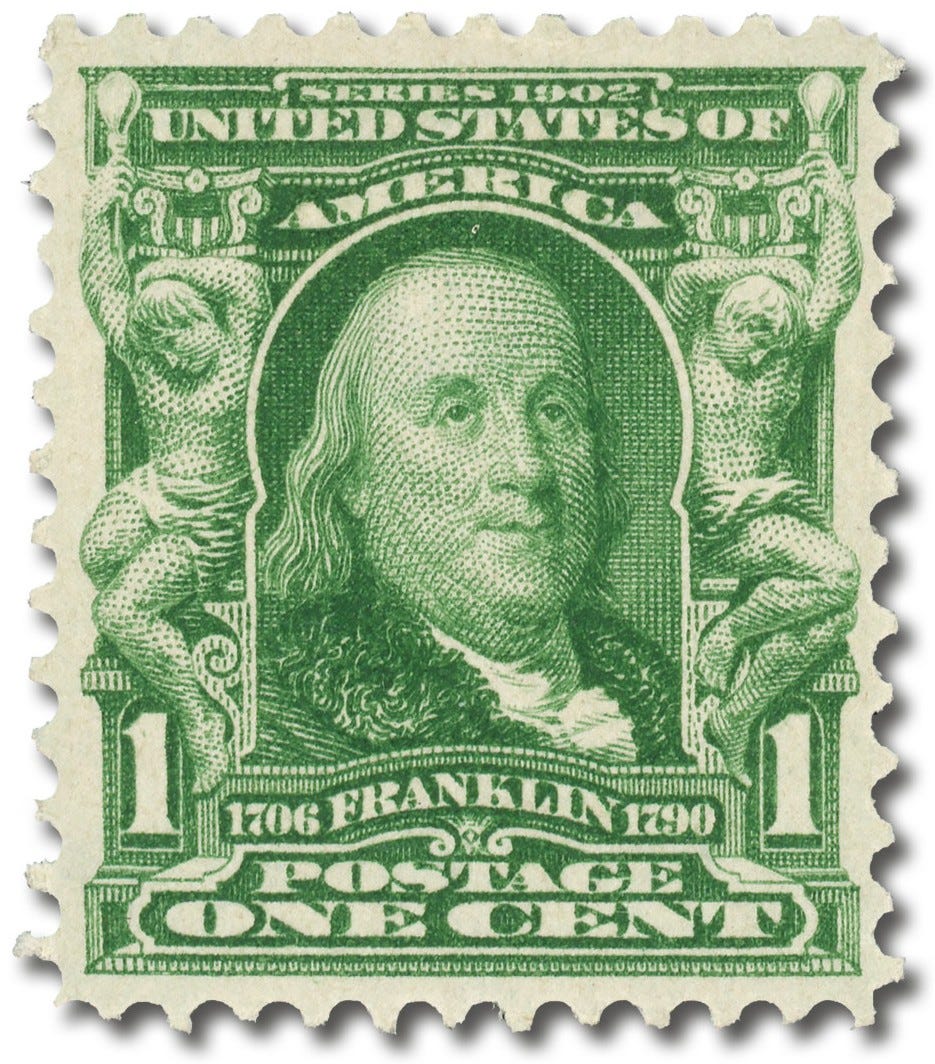
This year we are celebrating our country’s 250th birthday. Our postal service does us one year better, having been established in 1775, with our first postmaster being none other than Benjamin Franklin. 251 years later, it may be time for Congress to bring meaningful reform to this creaky and increasingly costly institution.
Reform Congress is a collaboration between Liz Terwilliger and Stephen Wahrhaftig.
Recently, the Postmaster General David Steiner was admirably forthright about this problem when he testified to the House in March. About 71% of his delivery routes, he said, are financially underwater. Despite the USPS’s recent price increases, the cost of a first-class stamp in the U.S. remains “the lowest in the industrialized world,” he added. “We deliver from the tip of Puerto Rico to the tip of Alaska for 78 cents. That’s a distance of 5,000 miles.”