
The Imaginary Debt Ceiling
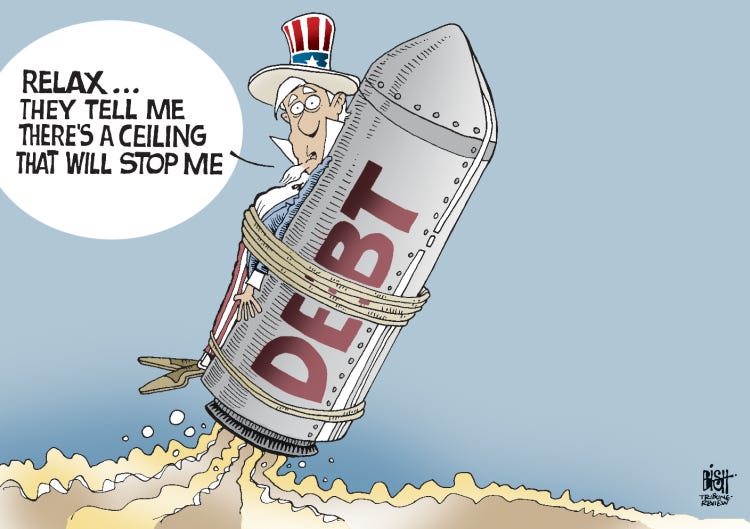
For weeks, the media has been wallpapered with hysterical stories about the anticipated apocalypse of the dreaded Debt Ceiling. As usual, the ceiling was raised, with no serious effect on our economy (or on government spending at all). The lead-up to the announcement did afford us some much-needed comic relief.
For example, one of the underappreciated facets of New York Times columnists is their entertaining use of vivid imaginations. An excellent recent example (paywall) is Paul Krugman’s wishful dreaming about how the president might override Congress with various spending mechanisms. A new interpretation of the 14th amendment, (containing wording that applied to payment of Union soldier pensions, with nothing to do with debt limits). He mentions the always- amusing “Trillion Dollar Coin” or the highly imaginative ‘Perpetual Bonds’ with interest rates that are magically ‘paid forever’.
Even our aging chief executive acknowledged that these were not real options and settled into our time-honored tradition of pretending that the US debt limit has something to do with spending money. But alas, the money being discussed has already been spent. The debt discussion is just an attempt by Congress to convince us that they want to spend a little less. Someday. In the future. Still increasing debt, just more slowly.
This debt limit agreement eliminates the limit, completely, for a little while anyway. This is the very height of Looking-the-Other-Way hypocrisy. Democrats have already called for tearing up the agreement once they re-take the House, yet they passed on an opportunity to eliminate the ceiling completely last time they were in control.
Some people become unhappy with the fact that it is the purview of Congress to spend government funds. Congress controls expenses, the President does not (excepting limited emergencies). So, when the chief executive stamps his feet and claims that he ‘will never negotiate spending with Congress’ he is imagining something that is legally impossible. Of course, he is negotiating, that is his job.
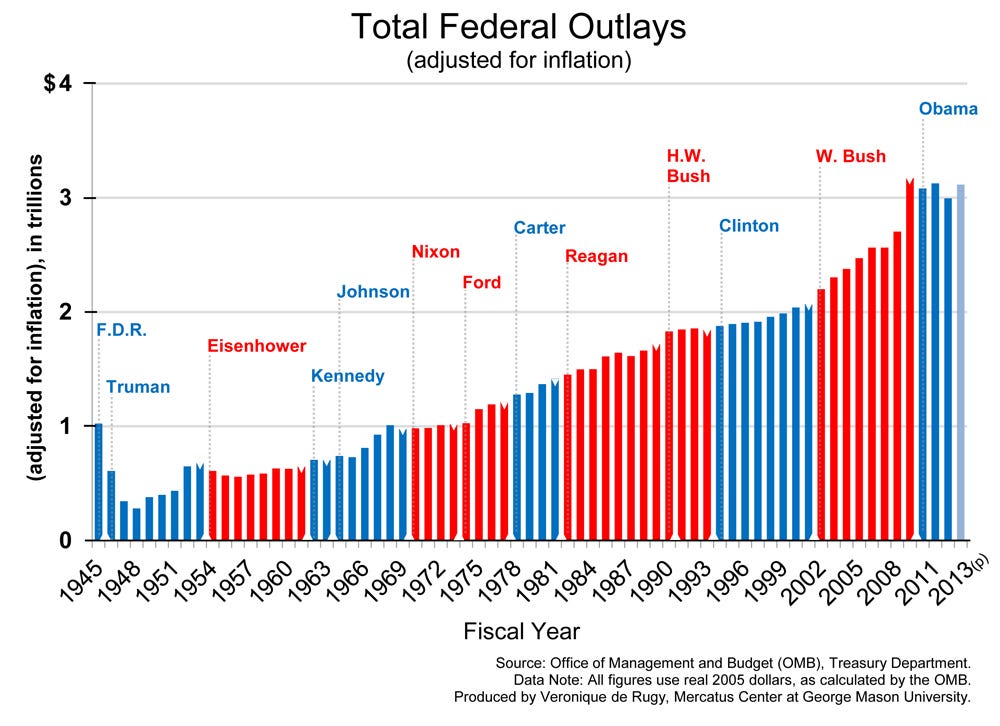
The truth is that both major parties have continued to spend more, with no sign of reversing that trend.
The Debt Limit is an outdated mechanism that permits the government to pay bills that it has already generated. You cannot max out your MasterCard then tell the bank that “you approved your expenses, but not your ability to pay them”. (If you try this ploy, please let us know how you make out).
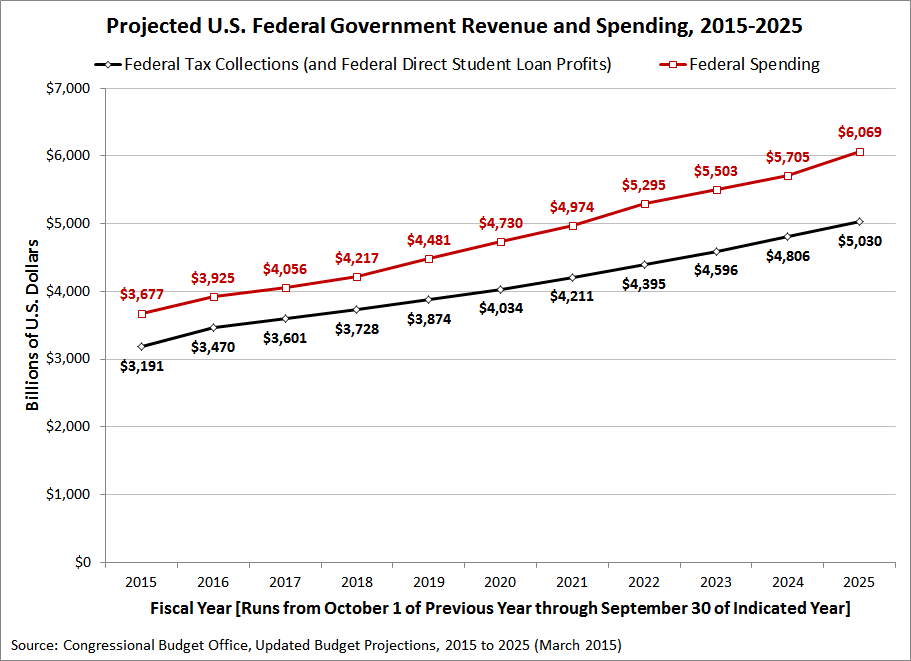
Our problem is not a Debt Limit. It is Debt. In simple terms, our federal tax revenue only covers a portion of our expenses. The result, of course, in increasing debt.
This growing debt has a special characteristic; the interest on our debt produces more debt. (Wait! Wait! Wait! We’ve discovered a means of perpetual motion!). In the last quarter of 2022 we paid a record $213 billion in interest payments alone! This financial hole is rapidly deepening, because debt matures, and then is refinanced at higher interest rates. This problem was less noticeable when interest rates were unnaturally low, but as we all now know, those days are over.
What does this deepening hole look like?
Well, The Congressional Budget Office says we will be spending $400 billion on interest payments alone this year. That comes to $3,055 per US household. As the CBO admits, we will spend more on interest payments than on: Social Security Disability Insurance, Food and Nutrition Services, Housing, and Transportation. Here’s a convenient chart:
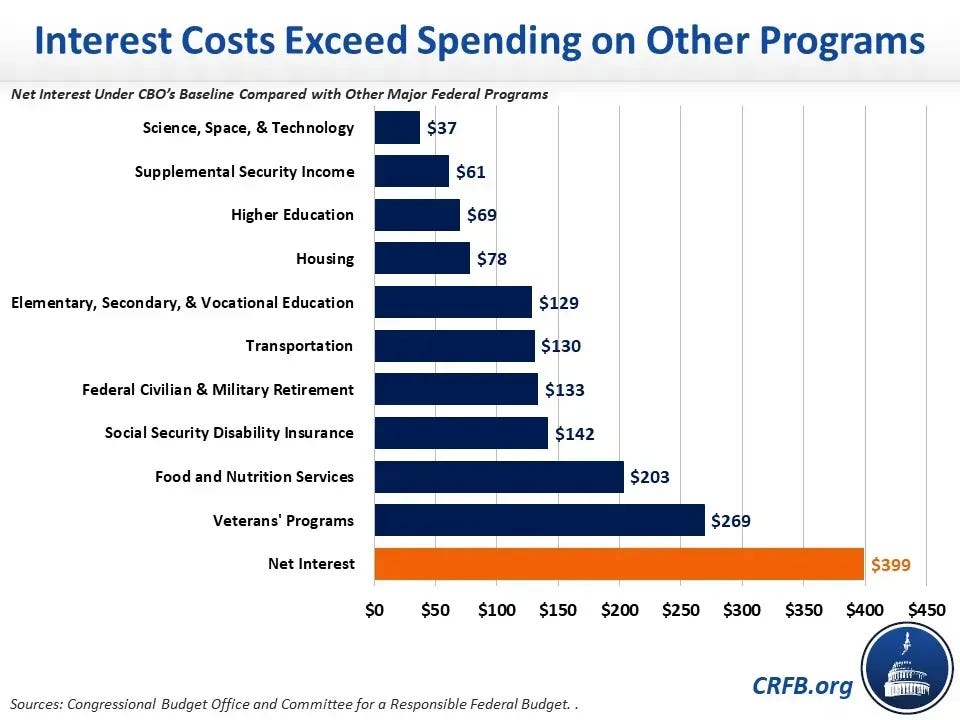
Note that the $400 billion is not debt, but only interest on the debt. What do you believe might be an adequate description of this financial situation? How about “Looming Disaster”?
In such a dire situation one might expect our congressional representatives to be screaming through the halls of the Capitol, urging immediate action to avert this Looming Disaster. But the last time I checked they were applying a band-aid and preparing to take some time off. (It is surprising to see how few days Congress is actually in session).
Why isn’t Congress more serious about curbing spending? Perhaps because, although the constitution says that Congress controls the government purse strings, they no longer do. They have abdicated their authority. Over the decades they created spending mechanisms that automatically increase on their own. By law, ironically passed by Congress, even Congress cannot change the majority of government annual outlays.
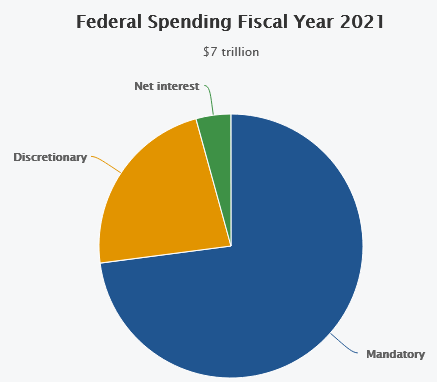
Congress votes on less than 30% of our annual expenses. The rest is either debt interest or programs like Social Security (49% of Mandatory Expenses), Medicare (38%), and a few other programs. None of these can be reduced, or even touched. Worse, they actually increase on their own with built-in mechanisms like Cost-of-Living increases.
With control over less than 30% of what is one of their main reasons for existing, Congress has become largely ineffective when it comes to controlling federal costs. Instead, they make a big deal over the small amount they control (which includes Defense). And they participate in this weird Debt Ceiling dance that has no bearing on any of this.
Our elected representatives are supposed to work in our best interests, which includes spending our tax dollars responsibly. In actually, they don’t control spending at all. Instead, the lion’s share of the federal budget is referred to as the “Third Rail”. Members of Congress view even the discussion of controlling mandatory spending as political suicide. Better to look the other way, pretend nothing is wrong, stay in office, collect a pension.
Perhaps they think the average taxpayer doesn’t care about our mounting national debt. If they believe that, they are wrong. In fact, the majority of Americans are worried about our growing debt. Two thirds of us believe that this debt is “an unfair legacy we are leaving to our children”, an accurate assessment of the situation.
It has become popular for the chief executive and various representatives to wave the flag of ‘National Security” to provide rational for spending ever more of their constituent’s money, adding to the mountain of debt. But are we really under any direct military threat? Do cheap imports, foreign wars, or even illegal immigration really impact national security or affect our ability to live prosperous lives? Not really.
I would argue that Congress and the Executive Branch are a real threat to our financial prosperity. Our own elected representatives are the people responsible for burdening us and future generations with ever-increasing debt and mandatory spending programs. If we can count on Congress for anything, it is to ignore the fundamental spending problem. Instead, they will make headlines about a Debt Ceiling that has no real limits.
75% of Americans worry about government spending. Each one of those concerned citizens is the only way uncaring representatives continue to get elected to office. It is high time these voters make their feelings known. If Congress will not control spending, then we need to control Congress.